


When night optics get reviewed, it’s usually done in a backyard or on a range.
That’s not how we do it.
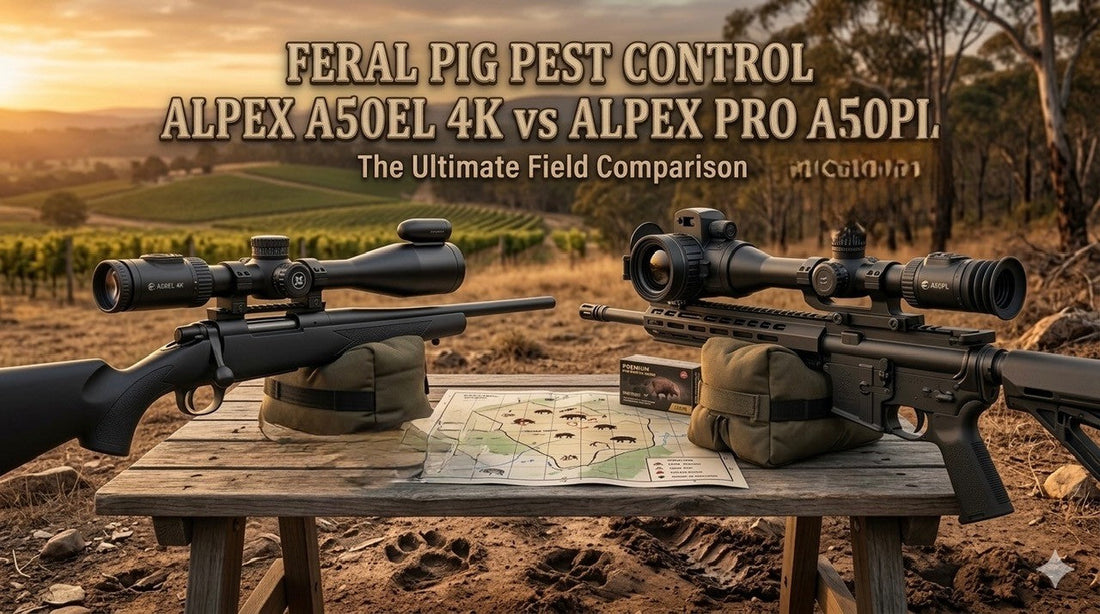
The HIKMICRO Alpex Pro A50PL and the HIKMICRO Alpex 4K A50EL were put through a proper field test on a working Hunter Valley property during a live pig control operation.
There were no controlled conditions, no staged targets, and no perfect lighting.
Just paddocks, feedlots, long grass, and pigs that destroy everything in their path.
Both scopes were run alongside the Speras TH4 4-in-1 Hunting Torch, which we later switched into IR mode once darkness settled in.
But the biggest surprise of the entire test actually happened before the IR torch was even turned on.
Field Test Insight
The biggest difference between the two scopes appeared during the fading light period before full darkness. The 6K sensor in the Alpex Pro A50PL pulled noticeably more detail out of the environment, making pigs easier to identify along fence lines and in long grass before IR illumination was needed.
Alpex Pro A50PL vs Alpex 4K A50EL – Key Specifications
| Feature | Alpex Pro A50PL | Alpex 4K A50EL |
|---|---|---|
| Sensor | 6K Sensor | 4K Sensor |
| Low Light Performance | Excellent before IR | Good |
| Zoom Clarity | Stronger detail retention | Softer at high zoom |
| Laser Rangefinder | 1200m | 1000m |
| Battery Life | ~7 hours | ~11 hours |
| Best Use | Low light performance and zoom clarity | Long runtime and daytime use |
The Conditions: Hunter Valley Reality
Anyone who hunts the Hunter Valley knows it’s not easy on optics.
During the test we had:
- Heat still rising from the ground late into the evening
- Humid air softening visibility across paddocks
- Long grass and scrub creating clutter in the image
- Pigs moving between feed areas and fence lines
Distances ranged from 80 metres out past 300 metres, which is typical for pest control work on open farmland.
We arrived on site in the late afternoon, and that’s when things started to get interesting.
The Moment the Difference Became Clear
Before darkness fully set in, pigs started appearing along a distant fence line as the light was fading fast.
This awkward transition between daylight and night is where digital optics often struggle.
It’s too dark for normal daytime performance, but not dark enough yet to rely on IR.
Looking through the Alpex 4K A50EL, the image was clean and sharp, exactly what you’d expect from a high-quality 4K digital scope.
Then we switched to the Alpex Pro A50PL.
The difference was immediately noticeable.
The 6K sensor in the Pro pulled noticeably more detail out of the fading light. Grass, fence posts, and the outline of pigs standing along the fence line were easier to separate from the background.
Where the 4K image began to flatten slightly as light dropped away, the 6K Pro retained more contrast and depth.
And again, this was before the IR torch was even turned on.
Hunter Tip
The transition between daylight and full darkness is when many digital scopes struggle. A higher resolution sensor like the 6K system in the Alpex Pro can give you valuable extra minutes of visibility before switching to IR.
Night Falls – Bringing the Speras TH4 Into Play
Once darkness settled in, we switched the Speras TH4 hunting torch over to IR mode.
The TH4 is a versatile 4-in-1 hunting torch with interchangeable modules:
- IR
- White
- Red
- Green
For night hunting with digital optics, the IR module is where it really shines.
With the beam adjusted for distance we were able to comfortably achieve:
- Detection past 300 metres
- Reliable identification around 200–250 metres
The adjustable beam also allowed us to tighten the IR hotspot when stretching shots across larger paddocks.
Image Performance in Real Hunting Conditions
Alpex 4K A50EL
Strengths
- Extremely crisp image at base magnification
- Excellent daytime performance
- Reliable performance with IR illumination
Where It Struggled Slightly
Like most digital optics, image softness begins to appear when digital zoom is pushed harder.
Alpex Pro A50PL (6K)
Strengths
- Sharper image when zooming
- Stronger contrast in heavy grass and scrub
- Better low-light performance before IR is used
The higher-resolution sensor allows the Pro to hold detail longer when zooming, which is critical when confirming what animal you’re looking at before taking a shot.
Out in Australian paddocks, that matters, because sometimes what looks like a pig at distance can quickly turn into a calf or kangaroo.
Built-In Rangefinder Advantage
Both scopes include integrated laser rangefinders, which are incredibly useful when hunting large open properties.
Alpex Pro A50PL
- Rangefinder out to 1200 metres
Alpex 4K A50EL
- Rangefinder out to 1000 metres
Battery Life
Alpex 4K A50EL
- Around 11 hours runtime
Alpex Pro A50PL
- Around 7 hours runtime
Shop the Optics Used in This Field Test
Speras TH4 Hunting Torch
The Speras TH4 4-in-1 hunting torch used in this test provides interchangeable modules for IR, white, red, and green light, making it extremely versatile for Australian hunting conditions.
Final Verdict From the Field
After several hours of real pest control work in Hunter Valley conditions, one thing became clear.
Both scopes are excellent pieces of gear.
But the Alpex Pro A50PL stood out in one critical moment, that late-afternoon transition when light is fading but IR hasn’t yet been turned on.
That’s where the 6K sensor showed its advantage, pulling more usable detail out of low light and making animals easier to identify earlier in the evening.
Once night fell and the Speras TH4 IR torch was running, both scopes performed well.
However, the Pro continued to hold detail better when zooming.
For hunters chasing pigs, foxes, and other pests across Australian farmland, that extra detail can make all the difference.
© 2026, Good Hunt Australia. All rights reserved.
Your cart
Your cart is empty

Recently viewed products
- Choosing a selection results in a full page refresh.
- Opens in a new window.