


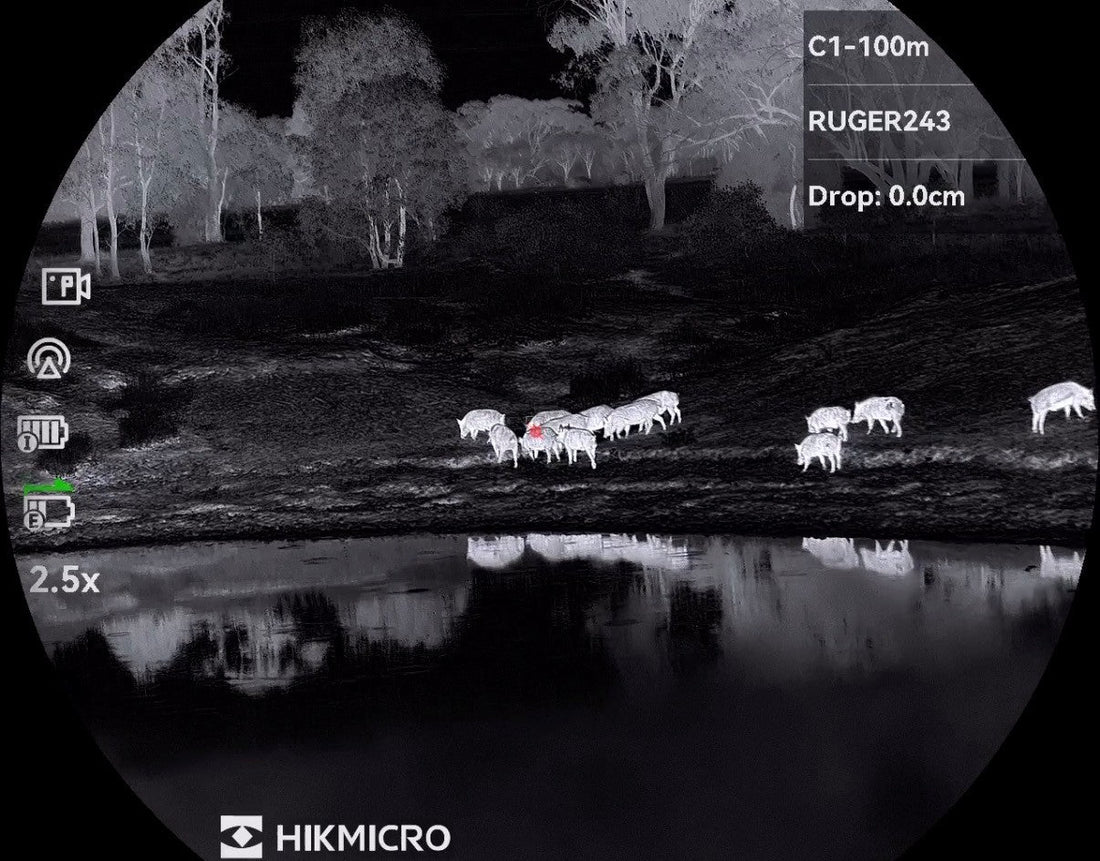
Real-World Performance in Australian Hunting & Pest Control Environments
When you’re running thermal optics in Australia, you don’t get perfect conditions. Warm ground, minimal contrast, moving targets, scrub, fences, and pressure to identify correctly — especially during professional pest control work.
That’s exactly why we’ve been running the Hikmicro Stellar SX60LS 3.0 (50 Hz) in the field and comparing it directly to the original Stellar SX60L — not just hunting, but on recent live pest control operations where performance actually matters.
If you’re splurging on a 1280 thermal device, this comparison will tell you which version of the Stellar platform truly earns its place on the rifle.
🧠 The Stellar Platform — Proven, Then Refined
The original Stellar SX60L built a solid reputation. With its 1280 × 1024 sensor, it delivered strong detection and dependable performance and became a popular choice for hunters and professional users stepping into high-resolution thermal.
But running the SX60L alongside the newer Stellar SX60LS 3.0 on real jobs quickly shows this isn’t just a generational refresh — it’s a refinement aimed squarely at warm, low-contrast environments like Australia.
Hikmicro didn’t reinvent the platform.
They fixed the weak points.
🌟 Stellar SX60LS 3.0 — Where the Upgrades Show in the Field
On a recent pest control job, we deliberately ran the SX60LS in conditions that expose thermal limitations — warm nights, heat-soaked ground, and animals moving through broken cover.
The upgrades were noticeable immediately.
- 🔥 NETD ≤ 15 mK (vs 18 mK on SX60L) – finer thermal sensitivity when everything is close to the same temperature
- ⚡ 50 Hz refresh rate – smoother image and better tracking of moving animals
- 🔍 1280 × 1024 @ 12 µm sensor – exceptional detail, now better utilised
- 🧠 Image Pro 2.0 processing – cleaner edges, reduced background noise
- 🎯 Integrated 1,000 m LRF (LS model) – accurate ranging without extra gear
- 🔋 Updated power system – built for long nights in the paddock
Instead of fighting the image, the SX60LS lets you focus on the job.
📦 Stellar SX60L — Still Capable, Just Less Forgiving
The Stellar SX60L hasn’t suddenly become obsolete. It still detects well at range and remains effective in cooler conditions or slower-paced hunting.
However, when used side-by-side during pest control work, its limitations become clearer:
- 18 mK NETD struggles more when ground and animals equalise in temperature
- Lower refresh rate makes fast movement feel less natural
- More time spent confirming targets in partial concealment
It works — but it requires more effort and more second-guessing.
📊 Side-by-Side Comparison
| Feature | Stellar SX60LS 3.0 (50 Hz) | Stellar SX60L |
|---|---|---|
| Sensor | 1280 × 1024 @ 12 µm | 1280 × 1024 @ 12 µm |
| Refresh Rate | 50 Hz | ~25 Hz |
| NETD (Sensitivity) | ≤ 15 mK | ≤ 18 mK |
| Image Processing | Image Pro 2.0 | Standard |
| Moving Target Tracking | Smooth & natural | Slower |
🇦🇺 Australian Conditions — Where the SX60LS Earns Its Keep
🐗 Warm Nights & Broken Scrub
During our recent pest control operation, animals moving through grass lines and fence breaks were picked up earlier and with clearer definition on the SX60LS.
The 15 mK NETD meant partial concealment didn’t wash the image out.
⚡ Moving Targets Under Pressure
The 50 Hz refresh rate proved invaluable when animals changed direction or broke into open ground. The image stayed fluid and easy to track.
🌡️ Heat-Soaked, Low-Contrast Ground
This is where Australian conditions punish thermal gear. The SX60LS reduced eye strain, sped up identification, and eliminated much of the guesswork seen with older-generation units.
🎯 If You’re Splurging on 1280 Thermal — This Is the Version to Buy
If you’re already investing in a 1280 thermal device, the Stellar SX60LS 3.0 is the most refined version of the platform.
- ✔ Regular hunting or pest control work
- ✔ Warm, low-contrast environments
- ✔ Moving targets in scrub or open ground
- ✔ Faster identification with less hesitation
🏁 Final Verdict — Proven in the Field
After running the Hikmicro Stellar SX60LS 3.0 (50 Hz) on a recent pest control job, the upgrades proved themselves where it counts.
The move from 18 mK to 15 mK NETD, combined with a smoother 50 Hz refresh rate and improved processing, directly improves identification speed, tracking confidence, and efficiency in real Australian conditions.
This isn’t just Hikmicro updating a flagship.
It’s Hikmicro finishing it properly.
© 2026, Good Hunt Australia. All rights reserved.
Your cart
Your cart is empty

Recently viewed products
- Choosing a selection results in a full page refresh.
- Opens in a new window.