


How Thermal Imaging Works: A Simple Guide
Imagine spotting a fox glowing against a cold paddock in the middle of the night, with no visible light. This is the power of...
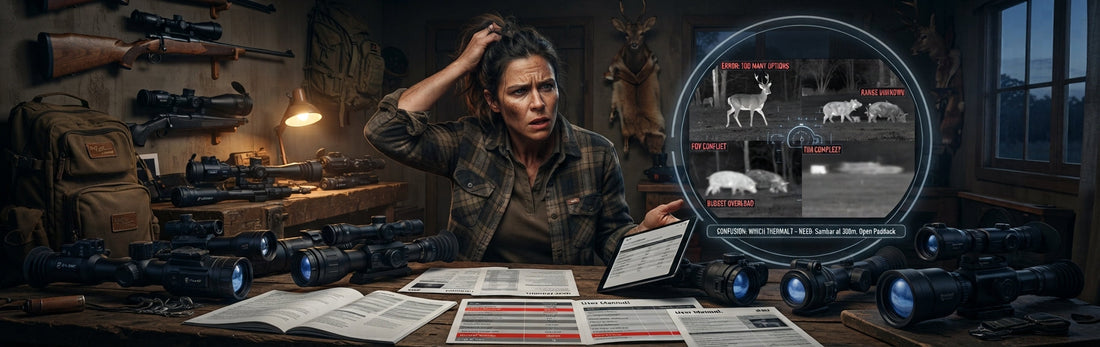

The HikMicro Stellar SX60LS 3.0 is HikMicro's flagship thermal scope, delivering exceptional long-range target detection, crystal-clear thermal ima...

The right thermal scope for your hunting needs by comparing sensor resolution, detection range, thermal sensitivity, magnification, and battery life. The best thermal scope is not always the most expensive one; it depends on the terrain you hunt, the distances you need to cover, and how you plan to use it.
Before making a purchase, consider the specifications that affect real-world performance. A 384×288 thermal sensor may be suitable for general hunting, while a 640×512 sensor provides more image detail for identifying heat signatures at longer distances. Similarly, lens size, NETD rating, refresh rate, and display quality all influence how clearly you can detect and observe animals in different conditions.
In this guide, we will guide you through the key features to look for when choosing a thermal scope, explain how different specifications affect hunting performance, and help you find an option that suits your requirements and budget.
You'll find numerous models of thermal scopes from different popular brands like Hikmicro, Nocpix, Pard, Guide and Rix. But, choosing the right thermal riflescope can make your hunting experience more effective and informed. It helps you detect heat signatures, observe animal movement, and assess your surroundings when visibility is limited. However, the quality of your thermal image depends on factors such as sensor resolution, thermal sensitivity (NETD), lens size, and magnification.
A riflescope that matches your hunting environment also makes a difference when scanning dense woodland or observing open terrain. With the right specifications, you can spot heat signatures more clearly, distinguish animals from their surroundings, and make better-informed hunting decisions. This is why understanding your hunting requirements before choosing a thermal riflescope is important.
Before you compare specs, work out how and where you hunt. Your answers decide which thermal scope suits you.
Choosing the right thermal riflescope is all about finding the features that suit your hunting needs. Specifications such as sensor resolution, thermal sensitivity, lens size, and detection range all influence image clarity and performance in the field. Below, we'll look at the key features to consider before purchasing a thermal riflescope.
The sensor is the heart of a thermal scope, and resolution is the number that most affects image sharpness. More pixels mean more detail, which means easier identification at a distance.
| Sensor Resolution | What it suits | Trade-off |
|---|---|---|
| 256×192 | Entry-level, close-range work | Limited detail; identification gets harder past short range |
| 320×240 / 384×288 | Short to mid-range hunting, best value for most hunters | Less detail than higher resolutions at long range |
| 640×480 | Longer range, small targets, sharper identification | Higher price |
| 1024×768 and above | Professional and long-range use | Highest price and often heavier |
A 640×480 sensor has four times as many pixels as a 320×240 sensor, which is why the image looks noticeably sharper, and identification is more reliable at longer distances.
Pixel pitch is the size of each sensor pixel, measured in micrometres (µm). Smaller pixels, such as 12 µm, allow a more compact scope and a sharper image from the same sensor size. Larger pixels, such as 17 µm, can be more sensitive in low-contrast conditions. A lower pixel pitch is generally a good sign, but resolution and lens quality still matter more.
Thermal sensitivity, measured in NETD (Noise Equivalent Temperature Difference), indicates how well a thermal riflescope can detect small temperature differences between an animal and its surroundings. A lower NETD value generally means better sensitivity and more detailed thermal images, especially in challenging weather conditions. For hunting, consider a scope with a NETD of 25mK or lower for improved heat detection and image detail.
Detection range is the distance at which the scope can show that something warm is there. Higher-end scopes quote detection ranges of 1,500 m to 2,300 m or more. The distances you actually care about are shorter:
Recognition and identification distances are typically several hundred metres at most, so always compare them against your real shooting distance rather than the headline number.
Magnification makes the target look closer; field of view (FOV) is how wide an area you can see at once. You trade one for the other, so choose based on terrain.
Also check what kind of zoom you are getting. Optical magnification gives a true enlargement. Digital zoom just enlarges the sensor’s pixels, so image quality drops as you push it higher. A moderate optical base with smooth digital zoom on top is a sensible combination, but don’t treat the maximum digital zoom figure as real magnification.
Refresh rate plays an important role in how smoothly a thermal scope displays moving animals. A 30Hz refresh rate can work for general observation, while 50Hz or 60Hz provides smoother imaging when scanning or tracking fast-moving game. Image processing also helps improve contrast, sharpness, and heat signature visibility. Look for these features if you want clearer images and more responsive viewing during hunting.
Lens size affects how far a thermal scope can detect heat signatures and how much of the surroundings you can see. A 19mm or 25mm lens is suitable for close-range hunting, while a 35mm or 50mm lens offers better detection at longer distances. Aperture also influences image clarity, with a lower f-number, such as F1.0, allowing more infrared energy to reach the sensor. Choose a combination that matches your hunting distance and terrain.
A built-in laser rangefinder helps measure the distance between you and your target, providing more accurate distance information. Some thermal scopes also include a ballistic calculator that uses range and other shooting data to estimate bullet drop. These features can be useful when hunting at longer distances, helping you understand distance-related facto7rs before taking a shot.
Reticle options and ballistic features make a thermal riflescope more adaptable to different shooting requirements. Customizable reticles let you select the aiming pattern, colour, and style that feels comfortable for your hunting conditions. Some models also include a ballistic calculator and one-shot zeroing to simplify sight-in adjustments and account for factors such as distance and bullet drop. These features can be particularly useful when shooting at varying distances, giving you more control over scope settings and helping you make consistent aiming adjustments.
Also Read: Can you use a thermal scope during daytime?
Matching a thermal riflescope to your hunting scenario depends on the terrain, target distance, and type of game you pursue. For hunting in dense Australian bushland, a wider field of view helps you scan nearby surroundings, while open farmland and longer shooting distances may require a larger lens, higher sensor resolution, and greater detection range. Consider features such as thermal sensitivity (NETD), refresh rate, magnification, and battery life to ensure the scope suits your hunting conditions. The right combination of specifications helps you balance image clarity, target detection, and overall usability in the field.
For close-range forest hunting, a thermal riflescope with a wider field of view helps you spot animals moving through dense vegetation and wooded areas. A 19mm or 25mm lens is generally suitable for shorter distances, while a 384×288 sensor can provide sufficient image detail for many close-range situations. Look for a smooth 50Hz refresh rate, good thermal sensitivity, and adjustable colour palettes to help maintain clear images when tracking moving animals in changing forest conditions.
When hunting in dense forests, thick vegetation and limited visibility can make it difficult to spot animals moving nearby. A thermal riflescope with a wide field of view (FOV) and low base magnification (around 2x–3x) makes it easier to scan the surroundings and follow moving targets without constantly adjusting your aim. A sensor with an sNETD below 20 mK can also help detect subtle temperature differences in challenging conditions.
Weight and handling matter just as much when moving through woodland. A compact, lightweight riflescope, such as the Pulsar Talion series, offers easier handling and better rifle balance during extended stalking. For close-range hunting, prioritise a wide FOV, clear thermal imaging, and comfortable handling over maximum detection distance.
A thermal scope needs to handle more than just clear imaging, especially when hunting involves changing weather conditions, rough terrain and regular outdoor use. Look for a scope with an IP-rated, weather-resistant housing, such as IP67, to protect against dust, rain, and moisture. A shock-resistant body also helps it withstand recoil and accidental knocks in the field. Along with durability, consider practical features such as long battery life, built-in recording, Wi-Fi connectivity, and user-friendly controls. Also, check the manufacturer's operating temperature range if you regularly hunt in cold or wet conditions. These features help ensure reliable performance and convenience during extended hunting sessions.
A thermal riflescope needs to withstand the recoil of your rifle without losing its zero. Before buying, check the manufacturer's recoil resistance rating and make sure the scope is compatible with your rifle's calibre. A secure mounting system, such as Picatinny or Weaver rails, also helps maintain stability and consistent accuracy. Choose quality mounting rings or brackets that hold the scope firmly in place, particularly if you regularly hunt in rough terrain or travel long distances with your rifle.
Battery life is another important factor, especially during extended hunting trips where charging opportunities may be limited. Look for a thermal scope that offers around 5–8 hours of battery life or more, depending on its settings and operating conditions. Models with replaceable or rechargeable batteries provide added flexibility, while USB-C charging and external power bank compatibility can be useful for longer outings. Keep in mind that recording, Wi-Fi, and high screen brightness can drain the battery faster.
Hunting conditions can change quickly, so a thermal scope should be able to handle rain, dust, moisture, and temperature changes. Look for an IP67-rated housing for protection against dust and temporary water immersion. An operating temperature range of around -20°C to +50°C or wider is also worth considering for outdoor use. A durable aluminium or magnesium alloy body can provide additional protection against knocks and everyday field use.

Choosing a thermal scope is not just about getting the highest specifications. Some features may look impressive on paper but might not suit your actual hunting needs. Here are some common mistakes to avoid:
Focusing only on detection range: A long detection range does not guarantee clear target identification. Consider the recognition range at your typical hunting distance.
Before choosing a thermal scope for hunting, take a moment to review the features that matter most for your hunting style, shooting distance, and field conditions. Use this checklist to make sure you select a scope that meets your practical needs.
Before investing in a thermal scope, take the time to compare different models and consider how their features match your hunting requirements. Sensor resolution, thermal sensitivity (NETD), refresh rate, and field of view all influence image quality and target visibility. Also, consider magnification, battery life, recoil resistance, and weatherproofing to ensure the scope performs reliably in different hunting conditions. Rather than focusing only on advertised detection range, check recognition and identification distances to understand what you can realistically expect in the field.
At Good Hunt, we understand that choosing the right thermal scope depends on your hunting environment, experience, and budget. Browse our thermal scopes to compare models from trusted brands and find equipment suited to your requirements. If you're unsure which model is right for you, contact our team for expert guidance to help you make an informed purchasing decision.
Not sure which gear actually suits your hunt? Book a live demo and get hands-on advice from people who use this stuff themselves. No guesswork. No pressure. Just straight answers.

© 2026, Good Hunt Australia. All rights reserved.
Your cart
Your cart is empty

Recently viewed products